
 Available in US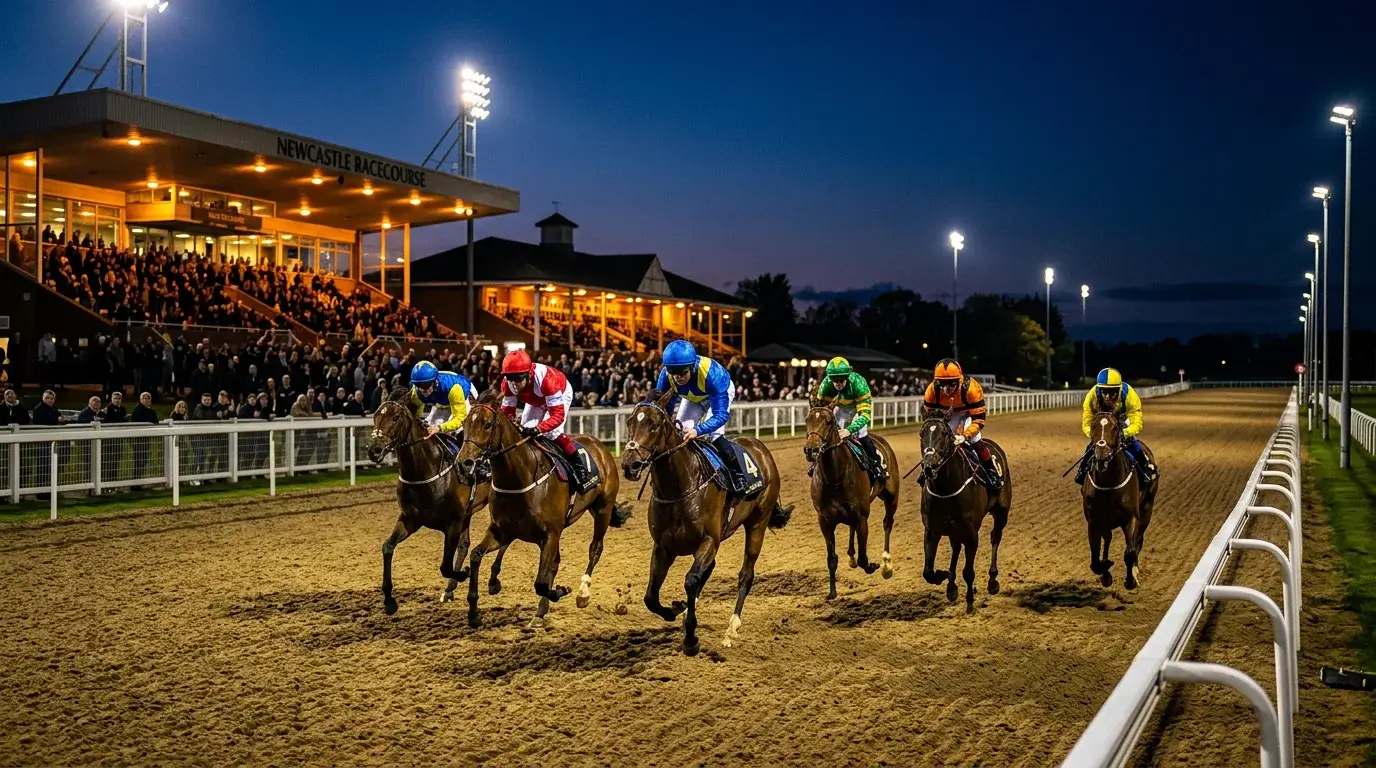
When afternoon shadows lengthen and office workers contemplate their evening plans, Newcastle racecourse transforms. Floodlights illuminate the Tapeta surface, transforming Gosforth Park into one of British racing’s most distinctive venues. Evening racing at Newcastle offers something afternoon cards cannot: accessibility for those whose working days prevent lunchtime attendance, combined with an atmosphere that crackles with after-work energy.
Newcastle pioneered floodlit all-weather racing in Britain, installing lights that allowed meetings to extend into darkness while maintaining racing quality. The eighty to ninety race days staged annually at Gosforth Park include a significant evening programme, with twilight meetings particularly popular during spring and autumn when daylight fades early but temperatures remain comfortable.
For punters, evening racing presents distinct characteristics. Field composition differs from afternoon cards, going conditions evolve as temperatures drop, and the betting market itself operates differently with many casual backers absent. Understanding these evening-specific factors provides edges unavailable to those who approach twilight cards with afternoon assumptions.
Newcastle Evening Racing — More on this topic at newcastle horse racing results.
Schedule and Race Times
Newcastle’s evening meetings typically begin around 5:00pm or 5:30pm, with the final race scheduled before 9:00pm. This timing allows commuters to arrive from Newcastle city centre — a fifteen-minute Metro journey to Regent Centre station — without missing early races, while ensuring the card concludes at reasonable hours for those driving home.
Seasonal Distribution
Evening fixtures cluster in specific periods. Spring months from March through May see frequent twilight meetings as daylight extends but remains insufficient for traditional afternoon racing schedules. The all-weather programme absorbs these dates when turf tracks struggle with ground conditions, making Newcastle’s floodlit facility particularly valuable.
September through November brings another concentration of evening cards. As autumn darkens afternoons, Newcastle’s lights extend viable racing hours. Jump racing on the turf course sometimes features in evening slots during this period, offering unusual opportunities to watch National Hunt action under floodlights — a rarity in British racing.
Summer evening meetings exist but compete with longer daylight that permits afternoon racing elsewhere. Newcastle’s evening programme during June through August tends toward midweek slots, avoiding clashes with major Saturday meetings at premium venues. These midweek summer evenings often attract smaller but knowledgeable crowds, creating intimate atmospheres unusual for the sport.
Race Card Composition
Evening cards typically feature six or seven races, slightly fewer than major afternoon meetings. Race quality spans Class 3 through Class 6, with prestigious handicaps reserved for daytime fixtures when television coverage and larger attendances maximise exposure. This pattern creates opportunity: evening handicaps face scrutiny from fewer professionals, while Class 5 and 6 events — often dismissed as too lowly for serious analysis — reward those willing to study modest performers.
Maiden and novice races appear regularly on evening cards, with trainers using twilight fixtures to educate young horses away from the spotlight. A promising two-year-old debuting at Newcastle on a Wednesday evening attracts less market attention than one appearing at York on Saturday afternoon, yet potential remains identical. Astute punters note these education runs and monitor subsequent careers.
The Atmosphere Under Lights
Floodlit racing transforms the visual experience. Horses appear to glow against the dark track surface, their colours vivid beneath artificial light that eliminates the muted tones of overcast afternoon racing. The Tapeta itself reflects the floodlights, creating a bright strip that draws attention to the action in a way sunshine simply cannot match.
Crowds at evening meetings differ demographically from afternoon attendance. Younger racegoers predominate, many arriving directly from work in professional attire, their racing dress code less formal than Saturday-best but distinctly smart casual. Groups of colleagues celebrating birthdays or farewells feature prominently, their collective energy raising noise levels above typical afternoon murmurs.
The after-work dynamic creates distinct behaviours. Betting tends toward social activity rather than solitary analysis; groups pool resources for accumulator bets, their collective excitement building across the card regardless of results. This recreational betting pattern affects market formation — prices can drift irrationally when workplace syndicates ignore value propositions, or shorten when group enthusiasm fixes on a particular runner.
Seasonal Atmosphere Shifts
Spring and autumn evenings carry crispness that concentrates attention. Without summer heat or winter chill extremes, conditions suit extended outdoor time. Bars and viewing areas fill comfortably, their occupants drifting between social conversation and race-watching without the weather-driven urgency that empties enclosures during afternoon extremes.
Winter evening meetings — rarer but not unknown — create different atmospheres entirely. Cold concentrates crowds into heated areas, with viewing limited to essential moments before and during races. These meetings attract hardcore regulars rather than casual visitors, their reduced attendance creating almost conspiratorial atmospheres where everyone present shares genuine racing interest.
Betting Considerations for Evening Cards
Evening racing markets operate differently from afternoon equivalents. Understanding these differences — rather than applying daytime assumptions — provides genuine betting edges.
Market Efficiency
Afternoon racing, particularly at major venues, attracts professional attention that rapidly corrects market inefficiencies. Evening cards at Newcastle receive less scrutiny. Professional backers may skip modest midweek meetings entirely, their attention focused on following day’s higher-quality fixtures. This creates opportunities: value prices persist longer in evening markets, allowing punters who do their homework to secure better odds than equivalent afternoon opportunities would offer.
However, reduced market volume works both ways. A significant bet moves evening prices more dramatically than afternoon equivalents, meaning shrewd punters must balance position-taking against price sensitivity. Placing a £200 bet that shortens odds from 5/1 to 7/2 destroys much of the value sought. Smaller stakes, spread across multiple bookmakers, preserve edge better than concentrated positions on limited-liquidity markets.
Going Changes and Temperature Effects
Tapeta surfaces respond to temperature differently than turf. As evening cools the air, the synthetic surface often quickens slightly compared to afternoon conditions. This shift favours front-runners who can exploit pace advantages before closers organise challenges. Horses showing early speed in their form profiles gain subtle advantages in evening races compared to those requiring strong finishes.
Track staff may water the Tapeta during afternoon breaks, with effects becoming apparent as evening temperatures fall. Checking going reports immediately before betting — rather than relying on morning predictions — captures these evolving conditions. The official going description might remain “Standard” throughout, yet subtle changes affect outcomes in ways morning bettors cannot anticipate.
Field Quality Assessment
Evening fields sometimes include runners avoiding afternoon clashes. A trainer might split two similarly-rated horses between afternoon and evening cards, hoping to win both rather than running them against each other. Identifying such splits — checking whether stables have runners elsewhere that day — reveals which evening runners represent first-string efforts versus those sent north while better horses compete elsewhere.
Visitor Tips for Evening Meetings
Attending evening racing requires different preparation than afternoon visits. Transport considerations, dining timing, and weather readiness all shift when meetings extend into darkness.
Getting There and Home
Public transport remains viable for evening meetings, though schedules tighten after 9pm. The Metro service from Newcastle city centre runs until approximately 11:30pm, providing comfortable post-racing returns. From Regent Centre station to Gosforth Park takes perhaps fifteen minutes on foot — straightforward in daylight but requiring attention after dark. Torches prove useful for those car-parked in outer areas where floodlight coverage fades.
Driving offers flexibility but demands car park awareness. Main areas fill during popular meetings; arriving before the first race ensures proximity to exits when leaving. Post-meeting traffic typically clears quickly since evening crowds are smaller than major Saturday attendance, but the single access road can bottleneck briefly. Patience serves better than rushing.
Dining and Refreshments
Evening meeting timing suits dining at the course. Restaurants and food outlets remain open throughout, allowing arrivals to eat before or between early races. This represents an advantage over afternoon meetings where eating competes with prime racing action; evening schedules provide natural breaks during the 5:30pm-6:30pm period when most people feel ready for dinner.
Bars operate energetically during evening meetings, their trade concentrated into shorter windows than all-day fixtures. Queues build approaching popular races; purchasing drinks during quieter moments — immediately after a race when crowds disperse to study the next — avoids frustration. Those planning extended stays should pace consumption; nothing diminishes betting judgement faster than enthusiasm at the bar.
Weather Preparation
Evening temperatures drop notably, particularly in spring and autumn when most twilight meetings occur. Layers prove essential — warm enough for outdoor viewing but removable for indoor areas. Newcastle’s exposed location near the Northumberland coast means wind chill factors frequently exceed expectations based on headline temperatures alone.
Racing After Dark
Evening racing at Newcastle combines accessibility with atmosphere in ways afternoon meetings struggle to match. The floodlit spectacle draws crowds unable to attend daytime fixtures, their collective energy creating venues more akin to evening entertainment than traditional sport. For bettors, reduced professional scrutiny and evolving track conditions provide edges that reward preparation.
Whether attending in person or betting remotely, Newcastle’s evening programme deserves attention beyond casual dismissal. These meetings produce results as significant as afternoon equivalents, their horses competing with genuine ambition despite the twilight setting. The lights come on, the gates open, and racing continues — different in character but equal in opportunity.
See also Newcastle Jump Racing.
