
 Available in US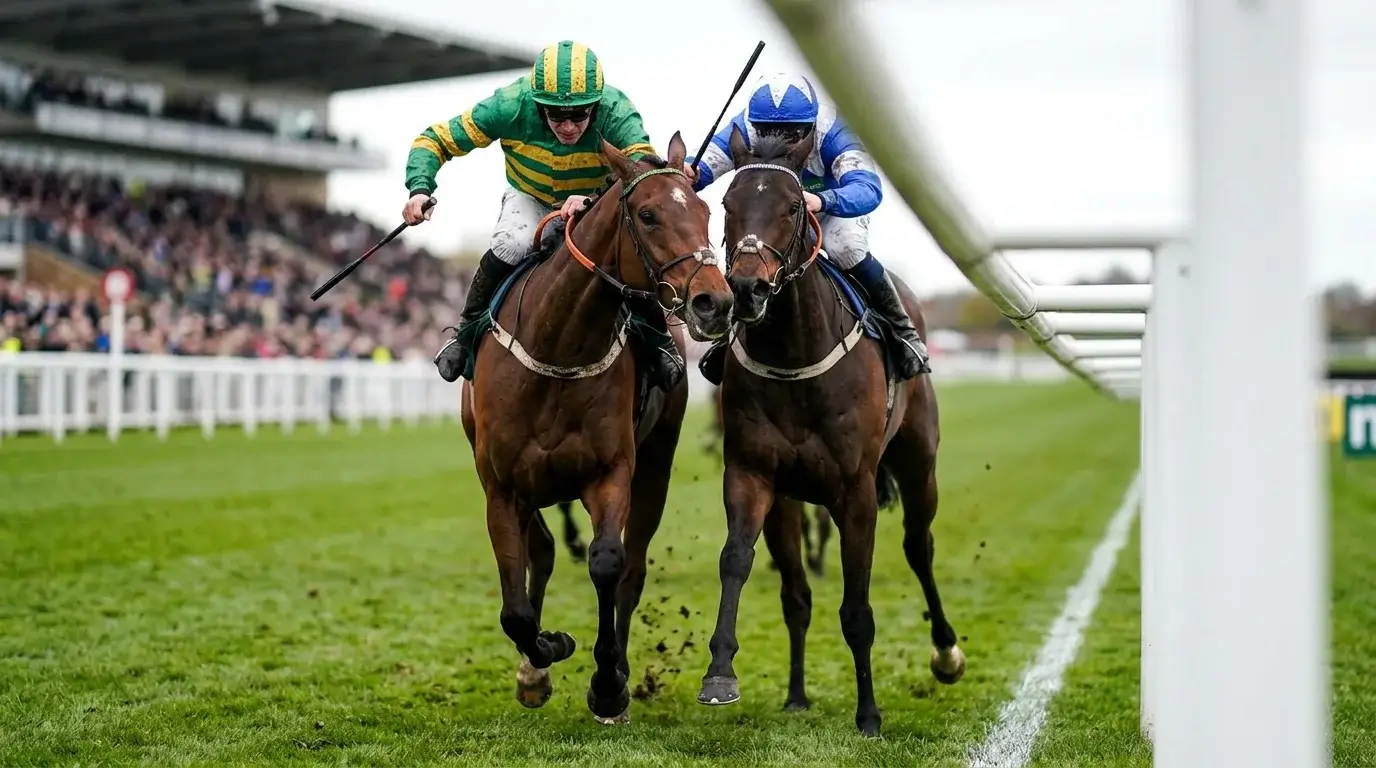
When horses cross the line together, the naked eye fails. Speeds exceeding thirty-five miles per hour, separated by centimetres — no human judge can reliably determine which nose reached the winning post first. This is where photo finish technology takes over, transforming millisecond margins into definitive results that settle bets and confirm winners.
Newcastle Racecourse, staging between eighty and ninety race days annually, produces its share of close finishes. The Tapeta surface’s consistency creates competitive racing where form advantages translate to narrow margins rather than runaway victories. Understanding how photo finishes work — and what the resulting images reveal — adds another dimension to following racing at Gosforth Park.
For bettors, close finishes carry financial significance beyond mere spectacle. A short-head verdict determines whether your selection won or placed, whether accumulators survive or collapse. Knowing how results are determined, what margins mean in practical terms, and how dead heats affect payouts transforms nail-biting finishes from pure anxiety into informed anticipation.
Newcastle Photo Finish — More on this topic at newcastle horse racing results.
Photo Finish Technology Explained
Modern photo finish systems bear little resemblance to the strip cameras of racing’s past. Digital technology captures thousands of frames per second, creating mirror-image strips that show precisely which horse’s nose reached the line first. The system operates automatically, eliminating human error from the most critical moment of every race.
How the Camera Works
Photo finish cameras don’t capture conventional photographs. Instead, they record a continuous vertical strip aligned exactly with the winning post. As horses cross the line, the camera captures a sliver of each moment, building a composite image that shows every runner’s position at the precise instant they passed the post.
This strip-camera approach explains why photo finish images look unusual — horses appear stretched or compressed depending on their speed relative to the camera’s scanning rate. A horse accelerating through the line appears narrower; one decelerating seems wider. The visual distortion has no effect on result accuracy; only the nose position at the winning post matters, and that’s captured with millimetre precision.
Timing Precision
Newcastle’s photo finish system records to one-thousandth of a second, though official times are published to the hundredth. This precision allows margins measured in centimetres to be accurately determined. The camera’s timestamp synchronises with beam-breaking sensors at the winning post, ensuring temporal accuracy matches spatial precision.
When judges examine photo finish images, they’re not estimating or interpreting — they’re reading objective data. The vertical line representing the winning post shows exactly where each horse’s nose was when crossing. If one pixel appears beyond another, that horse won. If pixels align identically, a dead heat results. The technology removes subjectivity from what was once a matter of human judgement.
From Capture to Announcement
Photo finish review typically takes between thirty seconds and two minutes, depending on finish closeness. Judges examine the primary image, then verify against backup cameras positioned at slightly different angles. Only when both sources confirm the same result does the announcement come. This dual-verification explains why obviously close finishes sometimes produce faster verdicts than apparently comfortable ones — clear separation requires less cross-checking.
Reading Winning Margins
Racing uses a hierarchy of margin descriptions, each representing approximate distances that experienced observers can estimate. Understanding these terms helps interpret results and assess future form — a horse beaten a short head ran closer than one beaten a neck, which in turn ran closer than one beaten a length.
The Margin Scale
The smallest official margin is a nose — roughly two to four inches between the winner’s nostril and the second horse’s. Next comes a short head, perhaps four to eight inches. A head represents approximately eight to twelve inches. These three margins all require photo finish examination and represent differences of perhaps one or two hundredths of a second at racing pace.
Beyond head margins, the scale extends to neck, half a length, three-quarters of a length, and then full lengths. A length equals roughly eight feet — the approximate distance from a horse’s nose to tail. Margins of a length or more rarely need photo finish confirmation; they’re visible to course judges without technological assistance.
What Margins Mean for Form
Close margins indicate tightly-matched ability under specific conditions. A horse beaten a short head at Newcastle on Standard going demonstrated ability within pounds of the winner that day. But context matters: was the winner receiving weight in a handicap? Did the beaten horse encounter trouble in running? Did track position favour one runner over another?
Repeated close defeats without victories suggest a horse that competes well but lacks the decisive acceleration to win. Such horses become reliable place prospects, hitting the frame consistently without quite getting up. Conversely, a horse winning by short margins demonstrates just enough class to prevail — not necessarily superior ability, but perhaps better temperament or tactical timing when races tighten.
Distance-Specific Patterns
Sprint races over five and six furlongs produce more photo finishes than longer events. The compressed timeframe leaves less room for class differences to manifest as wide margins. Newcastle’s straight sprint course, where runners race in line rather than navigating bends, creates particularly tight finishes — any draw advantage or break from the stalls can prove decisive.
Dead Heats and Divided Stakes
When photo finish technology cannot separate two horses — when their noses crossed the line at precisely the same moment — a dead heat is declared. Both horses are deemed winners; both receive the same prize money share. For bettors, dead heats trigger specific settlement rules that differ from normal wins.
How Dead Heat Payouts Work
Backing a horse that dead heats for first means receiving half your stake returned plus half the winning odds. A £10 bet at 4/1 on a dead heat winner returns £25: your £5 stake-back plus £20 in winnings, halved. This applies regardless of how many horses dead heat — if three shared first, you’d receive one-third stakes plus one-third odds.
Each-way bets on dead heat winners become more complex. The win portion follows dead heat rules; the place portion depends on how many horses now occupy place positions. If your selection dead-heated for first, they’re occupying first and second — meaning the place part pays in full, while only the win part divides.
Dead Heats for Places
More commonly, dead heats affect place positions rather than the win. Two horses might share second place, or three might tie for third. When this happens in each-way betting, place stakes divide accordingly. A dead heat for second in a race paying three places means your each-way place stake halves, while selections dead-heating for third might see place payouts reduced to one-third of normal.
Understanding these rules matters because dead heats occur more frequently than casual observers expect. Across a season at Newcastle, perhaps a dozen races produce dead heats of some form — not always for first, but often affecting place payouts in large fields where close finishes are common.
Notable Close Finishes at Newcastle
Newcastle’s competitive racing environment produces memorable finishes regularly. The average attendance of 3,404 per fixture witnesses close contests across both all-weather and jump cards, with the Tapeta surface’s fairness creating tight finishes where ability differences are minimal.
The Fighting Fifth Hurdle has produced several photo finish results over the decades, with Grade 1 contenders separated by margins that suggest championship-level equivalence rather than clear superiority. These finishes carry significance beyond the individual race — they influence Champion Hurdle betting markets and trainer planning for Cheltenham campaigns.
Handicaps at Newcastle regularly deliver blanket finishes. The weight allocation system, when working perfectly, creates fields where any runner might prevail. Saturday handicaps with full fields of sixteen or more runners frequently see five or six horses flash past the line together, with only the photo determining final positions. Such races offer value for each-way bettors — when margins are this tight, multiple selections can hit place positions.
The straight-course sprints deserve particular mention. Without bends to create positioning advantages, five-furlong specialists arrive at the line in clusters. Draw bias influences these races, but even accounting for stall positions, the margins often come down to who broke quickest and held their line truest. A head here, a nose there — photo finish technology works overtime on Newcastle’s sprint afternoons.
When Millimetres Matter
Photo finish technology removes doubt from racing’s most contested moments. What once required fallible human judgement now relies on objective measurement, ensuring every winner earns their victory through verifiable superiority — even if that superiority amounts to centimetres after a mile of racing.
For those following Newcastle racing, understanding photo finishes adds appreciation to close contests. The technology explains why some results take longer to announce than others, why dead heats occur, and why the margins in results summaries carry genuine meaning. When two horses flash past the winning post together, the wait for the photograph becomes part of racing’s drama — science settling what eyes cannot discern.
See also Newcastle Racecourse Facilities.
