
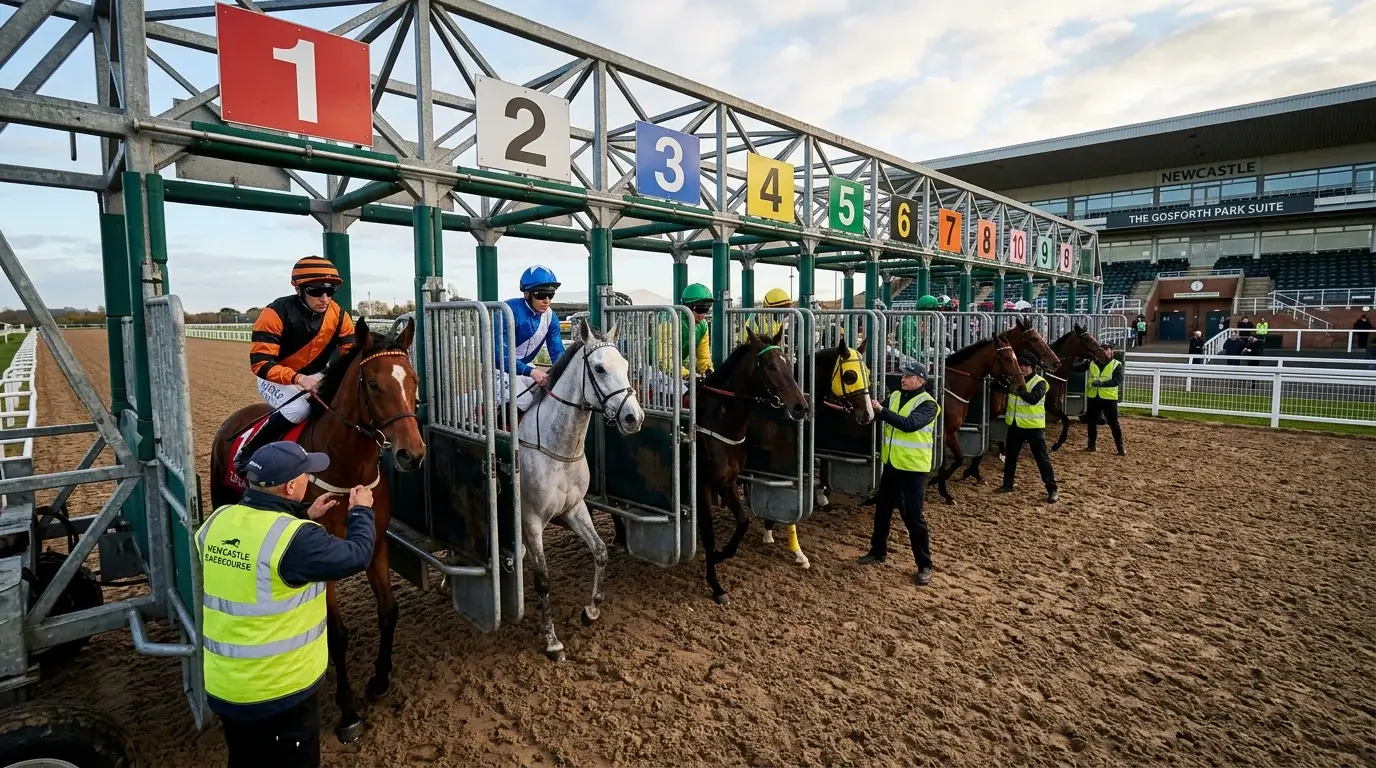
Newcastle draw bias represents one of the most actionable edges available to serious bettors on Britain’s all-weather circuit. While casual punters focus on form figures and trainer patterns, the starting stall from which a horse breaks can significantly influence its chances — and markets often fail to price this factor correctly. Understanding where advantages lie at different distances transforms raw probability into practical profit.
“The all-weather track I like the most is Newcastle; it’s very fair and has a good Tapeta surface,” John Gosden has noted. That assessment from a champion trainer captures something important: Newcastle’s Tapeta is fair in terms of surface quality, but fairness doesn’t mean every starting position offers equal opportunity. The track’s geometry, rail position, and racing patterns create biases that data analysis can quantify and betting strategy can exploit.
Newcastle’s unique configuration — a straight mile course combined with a 1m7f left-handed oval, making it the world’s largest synthetic racecourse — generates distinct bias patterns depending on which course races use. The straight produces different dynamics than the round track, and each distance within those configurations shows its own tendencies. This guide breaks down the data, explains the mechanisms, and provides practical betting applications for every common race distance at Gosforth Park.
What Is Draw Bias
Draw bias refers to the statistical advantage or disadvantage that horses experience based on their starting stall position. In a perfectly neutral race, stall 1 and stall 12 would produce equal winning rates over time. Reality differs. Track geometry, rail positioning, running patterns, and field behaviour create systematic advantages for certain starting positions that persist across hundreds of races.
Several factors generate bias. Track camber — the slight tilt built into racing surfaces for drainage — causes horses to drift naturally toward the lower side. Rail position matters because horses racing close to the inside boundary travel shorter distances than those forced wide. Field size affects how congestion develops: in large fields, horses drawn centrally may find themselves trapped, while those drawn toward the stands’ rail can establish position cleanly. Kickback, though reduced on Tapeta, still influences how jockeys ride horses starting behind others.
The metric that best captures draw effect is PRB: Percentage of Rivals Beaten. This measures what proportion of opponents a horse beats, expressed as a decimal. A horse finishing first beats 100% of rivals (PRB 1.00); a horse finishing last beats none (PRB 0.00). Across many races, a neutral stall would produce PRB 0.50 — beating half the field on average. When certain stalls consistently produce PRB above or below 0.50, bias exists.
PRB advantages might seem small in isolation. A stall showing PRB 0.55 versus PRB 0.45 doesn’t sound dramatic. But that 0.10 difference represents substantial edge across a horse’s career: the higher-PRB stall produces better finishing positions repeatedly, translating into more wins, more places, and more value when markets don’t adjust correctly. Compounded over a betting season, small PRB edges generate meaningful returns.
Newcastle’s bias patterns differ from other all-weather venues because of its unique configuration. The straight mile exists nowhere else on synthetic surfaces in Britain; the oval’s geometry creates its own dynamics. Understanding Newcastle requires Newcastle-specific analysis rather than generic all-weather assumptions. Data from Kempton or Lingfield doesn’t transfer — each track demands individual study.
Straight Course Analysis
Newcastle’s straight course runs from the five-furlong start through to a mile, with intermediate distances at six and seven furlongs. This configuration hosts sprint and mile races without bends, allowing pure speed assessment unaffected by turning ability. The geometry sounds neutral — a straight line should offer no positional advantage — but reality proves otherwise.
Analysis from GeeGeez demonstrates that high draws carry a consistent advantage on Newcastle’s straight course. Horses starting in higher-numbered stalls — those closer to the stands’ rail on the far side of the track — outperform those drawn low. The stands’ rail attracts runners naturally; horses gravitate toward it through the race, and those already positioned nearby travel shorter distances to reach favourable racing room.
The data is stark for the lowest stalls. Stalls 1 and 2 produce a PRB of just 0.45, meaning horses drawn there beat less than half their rivals on average. That’s a significant disadvantage embedded in the starting position, independent of horse quality. A good horse drawn in stall 2 still suffers compared to an equal horse drawn in stall 10; the positional handicap manifests in finishing positions repeatedly.
Why does this pattern emerge on a straight track? Several mechanisms combine. The stands’ rail offers the shortest route when horses drift toward it during racing. Jockeys know this, so they angle toward the rail from the start — but horses drawn low must cross more ground to reach favourable positions. Early pace often develops toward the stands’ side, forcing low draws to chase rather than lead. And in the closing stages, horses on the stands’ rail have the reference point of the boundary to guide their finishing effort.
Sprint races over five and six furlongs show the bias most clearly because the shorter distance offers less time to overcome positional disadvantage. A horse drawn poorly at five furlongs cannot gradually work across — the race ends before repositioning completes. Seven-furlong and mile races allow more time for manoeuvring, which dilutes but doesn’t eliminate the high-draw advantage. The pattern persists across straight-course distances; only the magnitude varies.
Practical application requires comparing drawn positions within specific races rather than applying blanket rules. In a twelve-runner sprint, stalls 1-3 face meaningful disadvantage; stalls 9-12 enjoy advantage; stalls 4-8 occupy neutral ground. Adjust expectations accordingly. A horse drawn 2 needs to be significantly better than rivals drawn high to overcome the positional handicap — and if the market doesn’t reflect that requirement, betting edges emerge.
Round Course Analysis
Newcastle’s oval circuit hosts races from 1m2f upward, with the 1m4f trip particularly significant due to both race volume and bias intensity. Left-handed throughout, the track features bends that create positional dynamics absent from the straight course. Here, draw bias operates through different mechanisms: access to the inside rail through turns, and the advantage of racing position into the first bend.
The 1m4f distance produces the most dramatic bias at Newcastle. Analysis of 119 races since 2017 shows that high draws win approximately twice as often as low draws at this trip. That’s not a marginal edge — it’s a fundamental advantage that markets consistently underestimate. Horses drawn high can angle toward the rail entering the first bend, establishing position without fighting for room. Horses drawn low must either use energy to secure rail position early or accept racing wide through turns.
The first bend determines much of the race outcome at 1m4f. High draws approach the turn from an angle that allows smooth transition to the rail; low draws face traffic and must navigate around rivals to achieve similar positioning. By the time the field settles into racing order, the positional work has already advantaged certain runners. This initial positioning echoes through the remaining distance, translating into finishing positions and ultimately into win rates.
Extended distances on the round course — 1m6f and 2m — show similar patterns though with reduced magnitude. The longer races allow more time for positional adjustments, diluting the first-bend advantage. But the principle remains: high draws at Newcastle’s oval course start with inherent advantages that low draws must overcome through superior ability or fortunate race dynamics.
Races at 1m2f occupy an interesting middle ground between straight-course and oval-course dynamics. The distance involves bends but covers less ground than 1m4f, compressing the time available for positional manoeuvring. High draws retain advantage, though the bias pattern blends elements from both course configurations. Studying 1m2f races specifically — rather than extrapolating from other distances — provides the most accurate assessment.
The round-course bias operates independently of pace scenarios and field quality. Whether races are run fast or slow, high draws outperform. Whether fields contain quality performers or moderate handicappers, the positional advantage persists. This consistency makes the bias reliable for betting purposes — it’s not a conditional effect that disappears under certain circumstances but a structural feature of how racing unfolds at Newcastle.
Distance-Specific Patterns
Each distance at Newcastle shows distinct bias characteristics that merit individual attention. General principles apply across the track, but optimal betting strategy requires distance-specific understanding. The following breakdown synthesises available data into actionable guidance.
Five furlongs: The shortest trip produces pronounced high-draw advantage. Races end quickly, leaving no time for repositioning. Stalls 1-3 suffer significantly; stalls 8-12 (depending on field size) benefit. Sprinters drawn low need substantial class advantage to overcome positional handicap. Markets often underadjust for this bias, creating value on well-drawn runners and suggesting caution on poorly-drawn favourites.
Six furlongs: Similar pattern to five furlongs with marginally reduced intensity. The extra furlong allows slight repositioning, but not enough to eliminate high-draw advantage. Stalls 1-2 remain problematic; middle draws become more viable than at five furlongs. The six-furlong trip sees heavy race volume, providing robust sample sizes for bias assessment.
Seven furlongs: High draws retain advantage but middle draws become genuinely competitive. The distance allows time for jockeys to find positions, reducing the immediate impact of starting stall. Stalls 1-3 still face disadvantage; stalls 7+ benefit. The transition from sprint to middle-distance racing begins here, with stamina factors starting to outweigh pure positional advantage.
One mile (straight): The longest straight-course distance shows the most diluted bias, though high draws maintain edge. Stalls 1-2 continue to underperform (PRB 0.45), but the underperformance manifests in positions rather than outright failures. Mile races on the straight often produce competitive finishes where starting stall contributed to margin without determining outcome entirely.
1m2f (round): First utilisation of the oval circuit introduces bend-related dynamics. High draws benefit from cleaner runs to the first turn. The bias operates differently than on the straight — here, it’s about racing room through bends rather than gravitating toward a particular rail. Field size significantly affects bias intensity at this trip.
1m4f (round): Maximum bias intensity at Newcastle. High draws win at double the rate of low draws across significant sample sizes. This trip demands particular attention from serious bettors — the edge available here exceeds what’s typically found elsewhere on Britain’s all-weather circuit. Never ignore draw at 1m4f.
1m6f and 2m (round): Staying distances show reduced but persistent high-draw advantage. The extended trips allow positional adjustments that mitigate first-bend impact, but don’t eliminate it. Stamina becomes the primary factor, with draw serving as tiebreaker between otherwise equal horses.
Field Size Impact
Field size modulates draw bias significantly at Newcastle. Small fields dilute the effect; large fields intensify it. Understanding this relationship prevents misapplication of general bias principles to specific race conditions.
Small fields of seven runners or fewer show diminished bias because positional congestion barely exists. With room to manoeuvre throughout, horses drawn poorly can navigate to preferred positions without difficulty. The mechanisms that generate bias — crowding, traffic, racing room competition — simply don’t apply when gaps exist everywhere. In small-field sprints, draw matters less than pure ability.
Medium fields of eight to twelve runners represent typical conditions where bias operates as described in general analysis. The sample sizes that generate PRB figures predominantly come from fields in this range, making the conclusions directly applicable. When Newcastle cards feature ten-runner handicaps, apply draw-based adjustments with confidence.
Large fields of thirteen or more runners amplify bias substantially. Congestion intensifies at every stage: the break, the first furlong, the approach to bends, the run to the line. Horses drawn poorly face compounded difficulties — they must overcome not just the track’s inherent geometry but also the physical presence of many rivals blocking optimal paths. Low draws in large-field sprints face steep obstacles that markets often underestimate.
Handicaps typically produce larger fields than conditions races, making draw analysis particularly relevant for the bread-and-butter events that comprise most Newcastle cards. When a sixteen-runner handicap goes off over six furlongs, draw becomes one of the most important factors in race assessment. The horse in stall 2 faces meaningfully worse prospects than the horse in stall 14, all else being equal — and handicaps theoretically make all else equal through weight allocation.
Betting strategy should adjust odds expectations based on field size. A 10/1 shot drawn 2 in a six-runner race might represent fair value; the same horse at the same price in a fourteen-runner field faces additional disadvantages that the price doesn’t compensate. Conversely, backing well-drawn runners in large fields offers value when markets focus on form to the exclusion of positional factors.
Going and Weather Conditions
Tapeta’s defining characteristic is consistency across weather conditions, and this stability extends to draw bias patterns. Unlike turf, where rain can transform a track’s geometry effects overnight, Newcastle’s synthetic surface maintains similar racing properties regardless of precipitation. The bias patterns described above persist through seasons and weather systems with remarkable reliability.
That said, subtle variations exist. Cold weather stiffens the wax component in Tapeta’s composition, marginally firming the surface. This might fractionally increase bias intensity on the straight course, as horses find less give and the sprint to the stands’ rail becomes even more decisive. Warm weather produces the opposite effect, marginally softening the surface and potentially allowing horses to sustain wider runs with less energy expenditure. These effects remain minor compared to turf going variations but exist for those tracking minute details.
Wet weather affects visibility more than surface properties. Heavy rain can impair horses’ vision when kickback increases, though Tapeta minimises this compared to other synthetic surfaces. Horses drawn where they’ll follow others through spray face modest disadvantage beyond the positional factors already discussed. The effect is minor and inconsistent, but worth noting during persistent rainfall.
Wind direction occasionally influences straight-course racing. A strong headwind in the closing stages can advantage horses who’ve conserved energy through the early furlongs — potentially favouring mid-pack stalkers over front-runners. This effect operates independently of draw bias but can interact with it: a horse drawn low who settles behind the leaders might benefit from both the cover provided by rivals and the energy saved by not fighting the wind. Weather-aware punters track forecast conditions as supplementary information.
Seasonal patterns in Newcastle’s fixture list mean certain biases get tested more frequently at particular times of year. Winter evening meetings under floodlights sometimes produce different pace dynamics than summer afternoon cards, though the draw effects remain consistent. Any perceived seasonal variation in bias likely reflects sample noise rather than genuine shifts in track behaviour.
Betting Applications
Converting draw bias knowledge into betting profit requires systematic application rather than occasional consideration. The following approaches translate data into practical strategy.
Mental odds adjustment: Before engaging with market prices, assess each horse’s draw and adjust your personal odds accordingly. A horse you’d rate 8/1 on form alone might become 6/1 if drawn advantageously, or 12/1 if drawn poorly. When the market offers 10/1, the well-drawn horse represents value while the poorly-drawn horse does not. This mental adjustment should precede all other analysis.
Opposing poorly-drawn favourites: Market leaders drawn in stalls 1-3 on the straight course, or drawn low for 1m4f races, face genuine disadvantages that short prices may not compensate. Laying these horses on exchanges, or simply excluding them from win betting, generates long-term profit when the bias manifests in beaten favourites. Not every poorly-drawn favourite loses — but enough do to make systematic opposition profitable.
Backing well-drawn outsiders: Conversely, horses drawn advantageously at bigger prices offer value invisible to punters ignoring stall position. A 16/1 shot drawn 11 in a large-field sprint has better prospects than that price suggests; the market has focused on form without accounting for positional advantage. These selections won’t win frequently, but when they do, the odds compensate handsomely.
Combining draw with pace analysis: Draw bias doesn’t operate in isolation. A front-runner drawn high enjoys double advantage: the positional benefit of the stall plus the tactical benefit of establishing early position without traffic. A closer drawn low faces double disadvantage: poor starting position plus the need to navigate through the field. When draw and running style align favourably, confidence in selection increases; when they conflict, expectations should temper.
Distance-specific staking: Given that 1m4f shows the strongest bias, consider increasing stakes on well-drawn selections at this trip. The edge is largest here, justifying greater financial commitment. Conversely, small-field races where bias diminishes might warrant reduced stakes or abstention despite attractive prices. Match stake sizes to confidence levels, and let bias strength inform confidence.
Record-keeping: Track your draw-based betting outcomes separately from general results. Over hundreds of bets, patterns emerge: are you profiting from opposing poorly-drawn favourites? Are well-drawn outsiders delivering as theory suggests? Data-driven refinement improves strategy over time. What works in abstract analysis must prove itself in actual markets.
Turning Data Into Edge
Newcastle draw bias offers one of British racing’s most reliable betting edges because it operates consistently across conditions and the market frequently ignores it. Understanding the patterns — high draws favour on the straight, high draws dramatically favour at 1m4f, field size amplifies effects — provides foundation for profitable engagement.
The key statistics bear repeating: stalls 1 and 2 produce PRB of 0.45 on the straight course, meaning horses drawn there beat less than half their rivals on average. At 1m4f, high draws win approximately twice as often as low draws. These aren’t marginal effects to be occasionally considered — they’re substantial advantages that should inform every Newcastle bet.
Implementation matters as much as knowledge. Systematic application of draw-based adjustments, combined with discipline to oppose poorly-drawn market leaders and support well-drawn outsiders, generates returns that casual approaches miss. The data exists; the edge exists; the only variable is whether punters choose to exploit it.
Newcastle racing will continue regardless of how you engage with it. The question is whether you’ll engage with the full information available, or whether you’ll cede edge to those who understand that starting stall matters. The choice, like the advantage, is yours.