
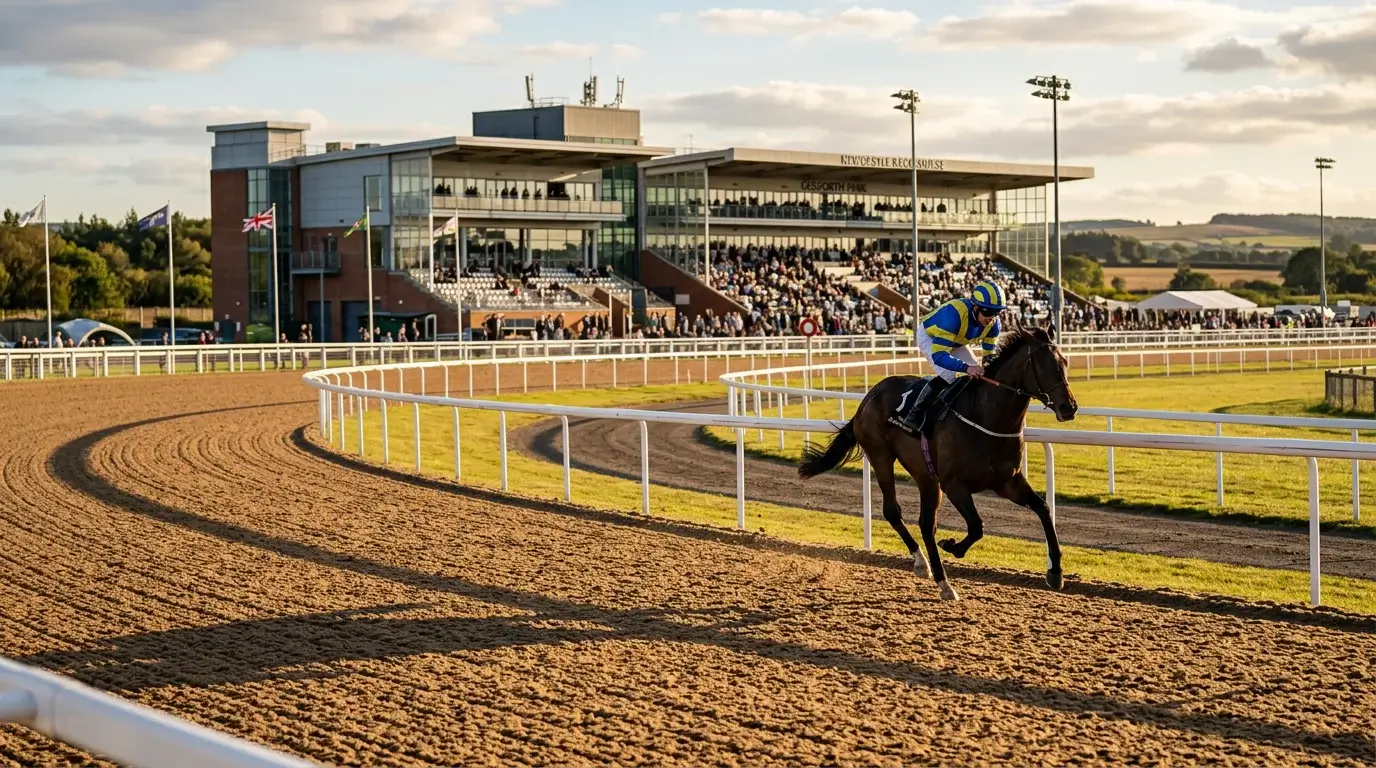
The Newcastle Tapeta surface changed everything about all-weather racing in Britain when it was installed in 2016. Before that, Gosforth Park had been a turf-only flat track for over 130 years — a beautiful venue that nonetheless left trainers yearning for an all-weather alternative in the north of England. The switch to Tapeta transformed Newcastle from a regional all-weather venue into the largest synthetic racecourse in the world, with its straight mile and 1m7f oval circuit offering configurations unavailable anywhere else on artificial ground.
Understanding Newcastle’s Tapeta surface matters for anyone who takes their betting seriously. Form on synthetic surfaces doesn’t always transfer cleanly to turf, and vice versa — horses that struggled on grass sometimes find their rhythm on Tapeta’s forgiving cushion. The surface composition differs fundamentally from Polytrack, Fibresand, and the natural turf courses that dominate British racing. Get your head around these differences, and you’ll spot value that casual punters miss.
This guide breaks down what Tapeta actually is, why Newcastle chose it, how it affects racing patterns, and what all of this means when you’re studying the form book. The technical bits matter, but we’ll keep them digestible. By the end, you’ll understand why certain trainers target Newcastle specifically, and how to factor surface preferences into your handicapping.
What Is Tapeta
Tapeta is a proprietary all-weather racing surface invented by Michael Dickinson, a man who understood horses with the obsessive precision of an engineer. Dickinson trained the first five finishers in the 1983 Cheltenham Gold Cup — a feat so absurd it still hasn’t been repeated — and later pivoted to studying how surfaces affect equine athletes. His creation emerged from years of experimentation at his Maryland training centre, where he tested compositions until he found something that mimicked the best qualities of natural turf while eliminating its worst.
The composition sounds deceptively simple: silica sand, wax coating, and a blend of rubber and synthetic fibres. In practice, the ratios and treatment processes determine everything. The silica sand provides the base structure and drainage, while the wax coating gives consistency across temperature ranges. When it rains, water passes through rather than pooling on top. When temperatures drop, the wax prevents the freeze-thaw cycles that crack lesser surfaces. The rubber and synthetic fibres add cushioning that absorbs impact — critical for reducing the concussive forces that damage horses’ legs over thousands of gallops.
Dickinson’s innovation was recognising that racehorse surfaces needed to serve multiple masters simultaneously. They had to drain fast enough for racing to continue through weather that would abandon meetings on turf. They had to provide grip without being abrasive. They had to cushion impact without becoming slow and holding. The balance he achieved with Tapeta earned its reputation not through marketing but through injury statistics and trainer testimonials.
The physical properties matter practically. Tapeta maintains what experts call “consistent biomechanical properties” — a technical way of saying it feels the same to the horse whether racing in March drizzle or August sunshine. Unlike turf, where ground conditions change hour by hour during a meeting, Tapeta remains predictable. This predictability translates directly into racing patterns: pace scenarios develop more reliably, and horses don’t face the sudden footing changes that cause injuries and throw off form calculations.
What distinguishes Tapeta from earlier synthetic surfaces like Fibresand is that earlier generation’s tendency toward kickback — the spray of material thrown up by hooves that peppers horses behind the leader. Fibresand was notorious for this, and horses would hang back to avoid getting their faces sandblasted, distorting running styles. Tapeta’s composition virtually eliminates kickback, letting horses race close together through the field without discomfort. That single improvement changed tactical approaches entirely.
Installation at Newcastle
Newcastle’s transition to Tapeta in 2016 came after nearly three decades on Fibresand, which had served its purpose but was showing its age. The Arena Racing Company, which operates Gosforth Park, had watched Wolverhampton’s successful Tapeta installation in 2014 and saw both the safety improvements and the positive trainer response. The decision to invest in a complete surface replacement rather than patching the existing track marked a commitment that would pay dividends in fixture allocation and field quality.
The installation covered Newcastle’s unique dual configuration: the straight mile course and the left-handed oval circuit extending to 1m7f. This combination exists nowhere else on synthetic surfaces worldwide, giving Newcastle its claim as the largest all-weather racecourse in the world. The straight mile allows sprint and mile races to be run without negotiating bends — a significant factor for speed horses who can maintain true pace throughout. The oval circuit handles the staying races and creates tactical variety that most synthetic tracks lack.
The project wasn’t merely laying new surface over old. Engineers stripped the existing Fibresand, assessed the drainage infrastructure, and prepared the base layers before applying the Tapeta composition. Temperature during installation affects the wax component’s bonding, requiring precise scheduling. Newcastle’s work happened outside the peak racing season, minimising disruption while allowing the surface to settle before competitive use.
What changed immediately was trainer attitude. Certain yards had avoided Newcastle during the Fibresand era, unconvinced by the surface’s fairness. When Tapeta bedded in, those trainers started entering horses. Field sizes improved. Better horses appeared. Newcastle’s all-weather cards began attracting quality that previously bypassed the northeast for Kempton or Wolverhampton. The investment in surface technology translated into sporting relevance.
Safety and Performance
The safety credentials of Tapeta aren’t marketing claims — they’re backed by biomechanical research. Studies conducted by Dr. Pratt and published through Tapeta Footings found that horses racing on Tapeta experience approximately 50% less concussion impact compared to dirt tracks. That reduction comes from the surface’s ability to absorb and distribute force through its fibre-and-wax matrix rather than transferring it directly up through the horse’s legs. Over a racing career spanning dozens of starts, that cumulative reduction in skeletal stress makes a meaningful difference.
“Racing at both Wolverhampton and Newcastle has benefited hugely from the installation of Tapeta,” noted Martin Cruddace, Chief Executive of Arena Racing Company. “It offers a number of benefits regarding its safety record, relative lack of kickback and fairness for horses.” That endorsement from the company running both tracks carries weight — they have direct access to veterinary reports and injury data across thousands of races on the surface.
The absence of kickback deserves emphasis. On Fibresand and some other synthetic surfaces, horses following the leader cop a faceful of material. The discomfort causes them to drop back, hang away from the rail, or refuse to race close to other horses. Tapeta’s composition stays put when struck by hooves. Horses can track a pace-setter closely without protection, which fundamentally changes how jockeys ride. Hold-up horses can sit third or fourth without suffering, and sustained runs from the rear become tactically viable.
Consistency across conditions might be Tapeta’s most underrated performance benefit. On turf, the going changes throughout a meeting — the first race might be Good to Firm, and by the sixth race, it’s Good after sustained pressure from hooves. Horses drawn in different races face materially different surfaces. Tapeta stays constant. The horse running in the opener faces the same footing as the horse running at twilight. This consistency eliminates an entire category of racing variables, allowing pure form comparison without going adjustments.
Injury rates tell the clinical story. While comprehensive UK-wide statistics require careful interpretation given different track configurations and race types, trainers report fewer soft tissue injuries on Tapeta than they encountered on earlier all-weather surfaces. Horses can race more frequently with confidence, recover faster between runs, and sustain longer careers. For owners calculating return on investment in bloodstock, those career longevity factors matter enormously.
One caveat: Tapeta isn’t injury-proof. Horses still pull muscles, clip heels, and encounter misfortune that no surface can prevent. What Tapeta does is remove surface-related causes from the equation. The injuries that do occur tend to stem from racing incidents or pre-existing conditions rather than concussive damage accumulated through repeated work on unforgiving ground.
Racing Characteristics on the Tapeta
Newcastle’s Tapeta hosts between 80 and 90 race days annually, providing a substantial sample for understanding how the surface shapes competition. The track’s dual configuration — straight mile plus oval — creates distinct racing patterns depending on course selection. Sprint races on the straight unfold differently from staying handicaps around the bend, and punters who recognise these patterns find edges invisible to those treating all Newcastle races identically.
On the straight course, pace is king. With no bends to negotiate, horses can maintain maximum velocity from start to finish. Front-runners often dominate because chasers can’t rely on the leader slowing into turns. The geometry favours speed over stamina, and horses drawn high generally enjoy a slight advantage — the rail on Newcastle’s straight favours those drawn away from it, contrary to most racecourses. We’ll examine draw bias in detail shortly, but the key principle is that straight-course sprints reward different attributes than the oval.
The oval circuit introduces tactical complexity. The left-handed turns tighten at certain points, requiring horses to shift balance and adjust stride. Jockeys who know the track save ground on the bends while those unfamiliar with the configuration swing wide and surrender lengths. Stamina becomes more important as distances extend beyond a mile, and the ability to quicken after navigating turns separates winners from also-rans. Horses with a pronounced turn of foot — the capacity to accelerate sharply when asked — thrive on the oval in ways they might not on the straight.
Breeding patterns emerge over time. Certain sires produce offspring that handle synthetic surfaces naturally, while others consistently fail to transmit all-weather ability. Sons and daughters of Exceed And Excel, for instance, have historically performed well on Tapeta, as have many Kodiac progeny. Conversely, some bloodlines that dominate on turf struggle to translate that form onto synthetic ground. Serious students of pedigree factor surface preferences into their calculations, using Newcastle results as data points alongside turf form.
Front-runners versus closers remains the eternal debate, and Tapeta has its say. Because the surface drains well and maintains its characteristics through meetings, late closers don’t benefit from front-runners tiring on deteriorating ground. The pace they’re chasing often remains genuine to the line. This dynamic means that horses with proven stamina need to prove it again on Tapeta rather than relying on collapsing leaders. Trainers preparing horses for Newcastle factor this into their work — getting them race-fit to sustain effort rather than relying on others to stop.
Weather interacts with racing patterns less dramatically than on turf but still matters. Cold temperatures slightly firm the surface as the wax component stiffens. Extreme heat can marginally soften it. Neither change approaches the transformation that heavy rain works on grass, but attentive punters note conditions. Horses who prefer faster ground might gain a tick on cold winter evenings; those who like a bit of cut could find warm summer cards slightly more suitable. These are marginal differences, but margins decide races.
Tapeta vs Other Surfaces
Britain’s all-weather scene divides into distinct surface types, each with characteristics that affect form translation. Understanding these differences prevents the cardinal sin of treating “all-weather” as a single homogeneous category. A horse that excels on Polytrack might flounder on Tapeta, and winners on Fibresand didn’t automatically succeed when tracks converted to newer surfaces.
Tapeta, as installed at Newcastle and Wolverhampton, combines wax-coated silica sand with synthetic fibres. The wax provides consistency across temperature ranges. The fibres add cushioning. Drainage happens through the material rather than around it. The result is a surface that feels firm but forgiving — fast enough for sprinters to post quick times, cushioned enough to protect joints through sustained effort.
Polytrack, found at Kempton, Lingfield, and Chelmsford, uses a different recipe: wax, recycled rubber, polypropylene fibres, and a sand base. The rubber component gives Polytrack its distinct feel — slightly more “bouncy” than Tapeta, some trainers say. Horses who generate power through a pronounced knee action sometimes prefer Polytrack’s responsive surface. Those who travel more flatly to the ground may find Tapeta’s firmer base more suitable. Form transfers between the two surfaces with reasonable reliability, but blind assumptions cause losing bets.
Fibresand, now only at Southwell in Britain, represented the first generation of modern synthetic surfaces. It’s exactly what the name suggests: sand mixed with fibrous material. Fibresand races slower than Tapeta or Polytrack, and the kickback issue makes it tactically distinct. Horses leading on Fibresand face less pressure because pursuers hang back to avoid the spray. When assessing Newcastle form for horses with Southwell experience, expect tactical patterns to diverge significantly.
Turf remains the benchmark against which all artificial surfaces are measured, however unfairly. Some purists dismiss all-weather form entirely, which is foolish — plenty of horses run their best races on synthetic ground. The practical question is how form translates between surfaces. Generally, horses who’ve shown ability on good-to-firm turf handle Tapeta’s characteristics. Those who need soft ground to produce their best often struggle. The correlation isn’t perfect, but it provides a starting framework for cross-surface assessment.
American dirt surfaces operate on entirely different principles and barely relate to British all-weather racing. Horses imported from the US with strong dirt form can’t be assumed to handle Tapeta without question. Some transfer beautifully; others find the cushioning unfamiliar after racing on harder American surfaces. The transatlantic form puzzle adds another layer when American-trained horses appear at Newcastle for international fixtures.
The practical upshot for punters: note not just whether a horse has all-weather form, but which specific surfaces that form was achieved on. A horse with three wins on Polytrack and nothing on Tapeta has an unknown element when appearing at Newcastle. Conversely, a Tapeta specialist with Newcastle and Wolverhampton wins deserves respect at face value. The details distinguish informed analysis from superficial assessment.
Betting Implications
Tapeta form analysis requires recalibrating assumptions that work on turf. The first principle: recent Newcastle or Wolverhampton form tells you more than distant all-weather form elsewhere. Horses who’ve run well at Newcastle within their last three starts demonstrate current Tapeta ability. Those who won on Polytrack two years ago and haven’t touched synthetic ground since represent unknowns despite their all-weather credentials.
Trainer statistics on Tapeta surfaces reveal specialists worth following. Certain yards develop expertise in preparing horses specifically for synthetic racing, understanding the nuances of gallops work that transfers to competition on artificial ground. Their runners outperform market expectations at Newcastle because the market doesn’t fully price in Tapeta-specific preparation. Tracking trainer strike rates at Newcastle over meaningful sample sizes — at least 50 runners — identifies those whose methods suit the surface.
Draw bias enters betting calculations prominently at Newcastle due to the straight-course configuration. On races between five furlongs and a mile using the straight track, analysis from GeeGeez shows that high-numbered stalls carry a consistent advantage. Stalls 1 and 2 produce a Percentage of Rivals Beaten of just 0.45 — meaning horses drawn there beat less than half their rivals on average, well below the expected 0.50 for a neutral draw. Meanwhile, high draws outperform, particularly as fields grow larger. Factoring draw into your assessments isn’t optional; it’s essential.
The 1m4f distance presents the starkest draw bias case. Analysis of 119 races since 2017 shows high draws winning approximately twice as often as low draws. That’s an enormous edge buried in the data, and markets don’t always reflect it. When a well-fancied horse draws stall 2 over 1m4f, the market price often fails to account for the positional disadvantage. Conversely, an outsider drawing high might offer value that disappears if you ignore stall position.
Form translation between Tapeta and turf follows patterns rather than rules. Horses who’ve won on good-to-firm turf frequently handle Newcastle without issue. Those who require soft or heavy ground struggle with Tapeta’s faster, firmer characteristics. When a horse attempts Newcastle after running exclusively on soft turf, approach with caution unless their breeding suggests synthetic aptitude. Sires matter here — certain stallions produce progeny with natural all-weather ability that transcends going preferences on grass.
Pace analysis pays dividends on Tapeta because the surface maintains consistency through races. On deteriorating turf, early pace can tire horses out as the ground shifts; on Tapeta, leaders must sustain genuine fractions or get caught. Study sectional times when available, and note horses who’ve shown ability to quicken after travelling strongly. That finishing speed separates winners from placed horses with mechanical regularity on Newcastle’s Tapeta surface.
Maintenance and Conditions
Tapeta requires regular maintenance to preserve its racing qualities, though less intensive intervention than natural turf demands. Newcastle’s ground staff harrow the surface between races, using specialist equipment to redistribute material and restore the optimal depth profile. This harrowing prevents compaction from accumulating and ensures the cushioning layer remains evenly distributed across the track width.
Watering happens strategically rather than constantly. Unlike turf courses chasing specific going descriptions through irrigation, Tapeta’s wax-coated composition means water doesn’t affect consistency as dramatically. Some watering maintains dust control and surface integrity, but the track doesn’t transform from fast to slow based on moisture levels. This stability explains why Newcastle can race through weather conditions that would force turf fixtures to inspect or abandon.
Temperature management matters more than rainfall for Tapeta conditions. Cold weather stiffens the wax component, making the surface marginally firmer and potentially faster. Extreme heat softens it slightly. Newcastle’s northeast location means winter racing often occurs in cold conditions that produce quick times, while summer meetings under warm evening lights might yield fractionally slower surfaces. These differences remain subtle compared to turf going variations but exist for those tracking minute data.
Going reports for Tapeta use a modified vocabulary. “Standard” describes the typical condition when the surface operates within its normal parameters. “Standard to Slow” indicates colder conditions firming the track slightly. “Standard to Fast” suggests warmer weather affecting the surface. The variations span a narrower range than turf going — there’s no Tapeta equivalent of heavy or bottomless ground, which is precisely the point. Horses entered at Newcastle know roughly what they’ll face regardless of forecast.
Track closures occur rarely but aren’t impossible. Extreme cold can freeze the surface beyond safe racing parameters, though Newcastle’s coastal location moderates temperature extremes compared to inland venues. Heavy snowfall obviously prevents racing until cleared. The drainage system handles rainfall efficiently, but truly exceptional precipitation might delay starts rather than force abandonment. Overall, Newcastle’s Tapeta calendar runs with remarkable reliability compared to turf alternatives — one reason trainers target the venue when needing consistent opportunities for their horses.
The Tapeta Edge
Newcastle’s Tapeta surface transformed Gosforth Park from a regional all-weather track into a venue of genuine significance. The combination of superior safety characteristics, consistent racing conditions, and unique dual-course configuration attracts quality horses and informed trainers. Understanding how this surface differs from Polytrack, Fibresand, and natural turf gives punters analytical advantages that casual bettors forfeit through ignorance.
The practical takeaways matter most. Recent Tapeta form at Newcastle or Wolverhampton indicates current synthetic ability. Draw bias on the straight course demands attention, particularly over sprint and mile distances. Trainer statistics reveal specialists whose preparation methods suit the surface. And pace scenarios develop more predictably than on turf because the ground doesn’t deteriorate through meetings.
Whether you’re following a favourite horse’s return to Newcastle or seeking value in competitive handicaps, surface knowledge sharpens every assessment. The Tapeta isn’t merely ground to race on — it’s a variable that shapes outcomes, identifies form, and creates opportunities for those willing to understand its characteristics. Master this surface, and Newcastle racing becomes less a lottery and more a solvable puzzle.